A decision model for bounded questions.
Send a state made of text, JSON or images plus named questions. Every answer comes back as a probability your code can act on. The form of each answer is fixed before inference.
Yes or no, as a probability.
"The receipt total matches the claimed amount."
The probability that the statement is true. Your code sets the threshold.
One of the options you define.
Which team should handle this ticket?
The most likely option, a probability for each, and a confidence from 0 to 1.
A position on an ordered scale.
How frustrated is the customer?
Probability per level and the weighted average, which can land between levels.
A decision model for bounded questions.
celeris-1-decision evaluates questions about a supplied state. The state can contain text, structured JSON, images, or combinations of these inputs. Each request contains one or more named questions describing what should be evaluated.
The model returns structured answers with probabilities that can be consumed directly by application logic. Unlike an open-ended generation request, the possible form of each answer is defined before inference.
A binary judgment, as a probability.
"The receipt total matches the claimed amount."
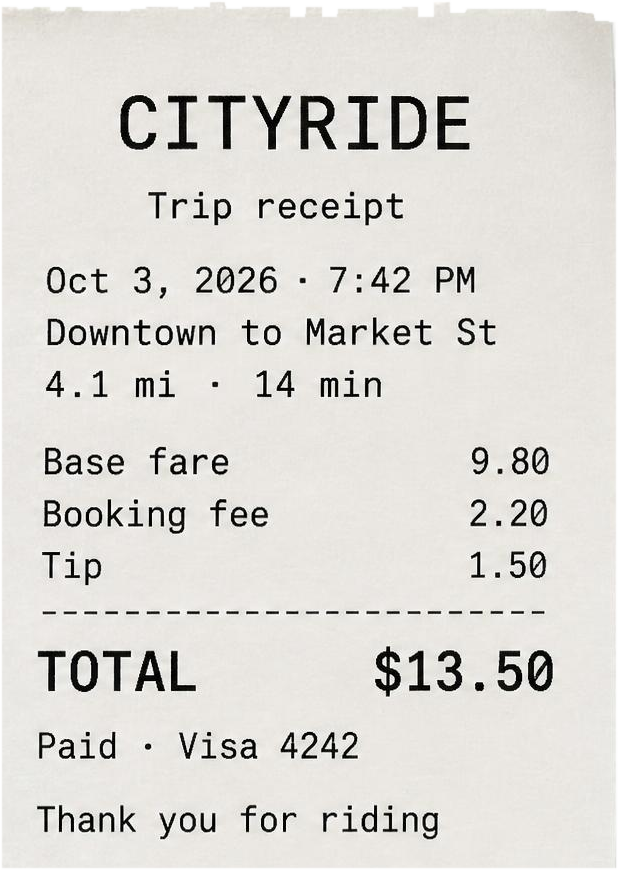
The answer is the probability that the statement is true. Here the state is a trip receipt image plus the expense record, and the question reads both. Optional criteria can describe the true and false outcomes. Your code sets the threshold.
A selection among named alternatives.
Which team should handle this ticket?
You define two or more options and describe each one. The response contains the most likely option, a probability for every option, and a confidence from 0 (an even split) to 1 (certainty).
A judgment over an ordered set of levels.
How frustrated is the customer?
You write the levels, lowest first. Probability mass is distributed across them, and the returned score is the probability-weighted average, so it can land between levels.